|
||
16. Shocked Iron Meteorites |
| Listing of Structures |
| Back...Next |
Meteorite -Tamarugal, IIIAB Iron. |
| Meteorite - Paloduro, IIIE Iron. |
| Meteorite - Deelfontein, IAB-mg Iron. |
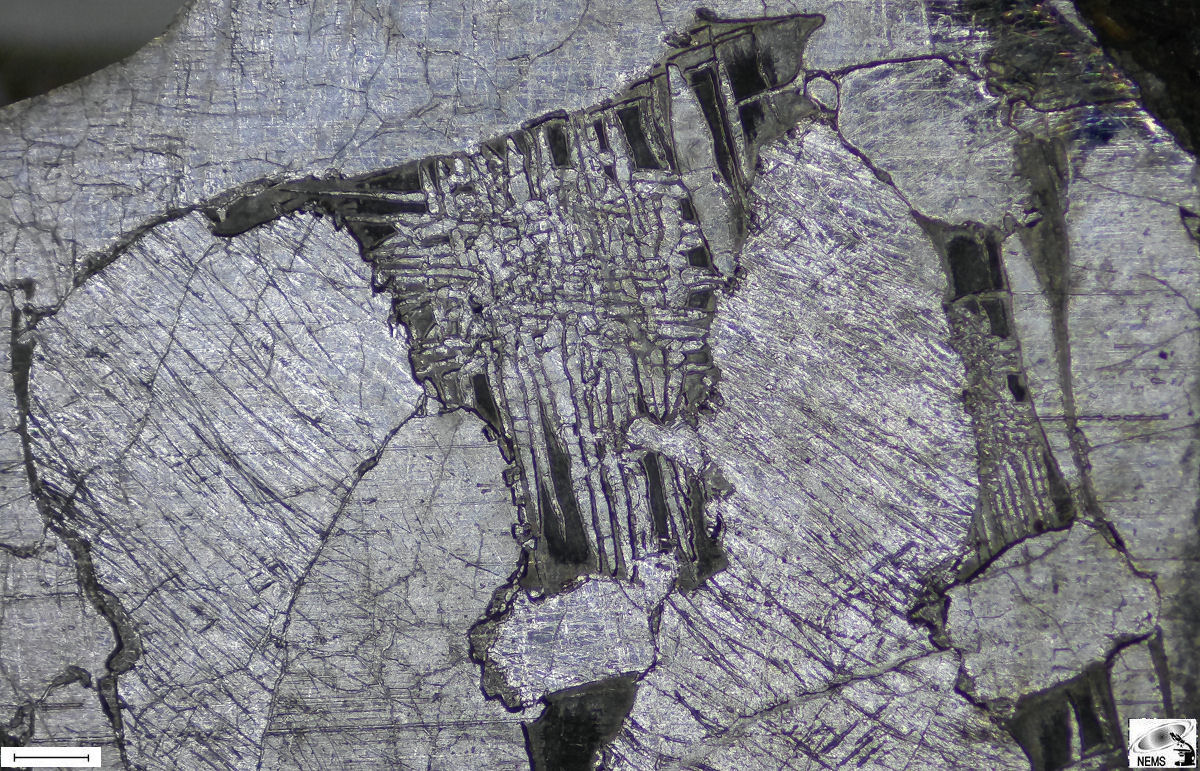 |
| Figure 1. Scale bar 700 µm |
| Tamarugal (IIIAB iron). Subboundaries in kamacite lamellae, basket-weave plessite field (center), and Neumann bands in multiple directions. |
| Shocked Irons
Meteorites: Tamarugal (IIIAB), Paloduro (IIIE), Deelfontein (IAB-MG) Shock Metamorphism in Iron Meteorites Shock features constitute some of the most prominent secondary structures in iron meteorites. These arise primarily from hypervelocity collisions in the asteroid belt or among planetoids prior to ejection toward Earth. Such impacts generated intense shock waves, transient heating, and deformation that overprinted primary solidification and cooling textures (e.g., Widmanstätten patterns, plessite, and inclusion assemblages). In extreme cases, collisions could catastrophically disrupt differentiated parent bodies, exposing and fragmenting their iron-nickel cores. As a result, nearly all iron meteorites exhibit some degree of shock alteration. Diagnostic secondary shock indicators include: • Neumann bands (mechanical twinning on {211} planes in kamacite) • Kamacite recrystallization and subgrain formation • Deformation and melting of troilite, cohenite, and graphite • Cross-hatched Neumann patterns (indicating multiple shock events or different orientations. • Increased microhardness due to work hardening and defect accumulation Microhardness as a Shock Indicator Post-cooling, unshocked kamacite and taenite typically exhibit Vickers hardness (HV) values around 155. Shock deformation dramatically increases hardness through dislocation multiplication and residual stresses, with values commonly reaching 270–380 HV and occasionally exceeding 475 HV in heavily deformed regions (Buchwald, 1975). These measurements provide a reliable, semi-quantitative proxy for shock intensity and help distinguish primary cooling effects from later collisional processing. Examples of Shocked iron meteorites Figure 1. Tamarugal (IIIAB iron). Subboundaries in kamacite lamellae, basket-weave plessite field (center), and Neumann bands in multiple directions. Vickers hardness: 270–335. Scale bar=700 µm. Figure 2. Paloduro (IIIE iron). Strongly shocked specimen showing melted troilite and recrystallized kamacite. Vickers hardness: 340. Scale bar=1.6 mm. Figure 3 Deelfontein (IAB-MG iron). Cross-hatched Neumann lines, deformed and shock-melted troilite, unidirectional texture in graphite, and severely corroded cohenite. Vickers hardness: 380. Scale bar=900 µm. Figure 4. Deelfontein (IAB-MG iron). Neumann lines, deformed and shock-melted troilite, severely corroded cohenite, and rhabdites. Vickers hardness: 380. Scale bar=600 µm. Figure 5. Deelfontein (IAB-MG iron). Elongated, decomposed cohenite inclusion. Vickers hardness: 380. Scale bar=400 µm. Discussion of meteorites in this section. • Tamarugal (IIIAB): Displays classic shock-induced subgrain boundaries in kamacite, multi-directional Neumann bands, and basket-weave plessite. The elevated hardness (270–335 HV) confirms significant plastic deformation without wholesale melting. • Paloduro (IIIE): Exhibits more intense shock effects, including troilite melting (indicating localized temperatures exceeding ~1000°C) and kamacite recrystallization. Hardness of 340 HV reflects strong deformation. • Deelfontein (IAB-MG): One of the more heavily shocked examples, with cross-hatched Neumann lines (evidence of complex stress fields), shock-melted troilite, graphite with flow-like unidirectional texture, severely corroded/decomposed cohenite, and abundant rhabdites. Hardness of 380 HV underscores intense shock processing. Of note: IAB-MG irons, often linked to impact-melt breccias on chondritic parent bodies, are particularly prone to recording such events. Broader Implications Shock features in irons like these provide critical windows into the collisional evolution of the early solar system. They complement cosmic-ray exposure ages and help model impact velocities, parent-body sizes, and disruption timescales. In some cases, shock melting of sulfides and carbides can mobilize phases, producing unusual textures or veins. Quantitative shock stage classification (analogous to those for ordinary chondrites) remains an active area of research in meteoritics. Continued metallographic and microanalytical studies of shocked irons enhance our understanding of dynamic processes in asteroidal environments and the delivery of meteoritic material to Earth. Specimens such as Tamarugal, Paloduro, and Deelfontein exemplify the prevalence and variability of shock overprints across different chemical groups. |
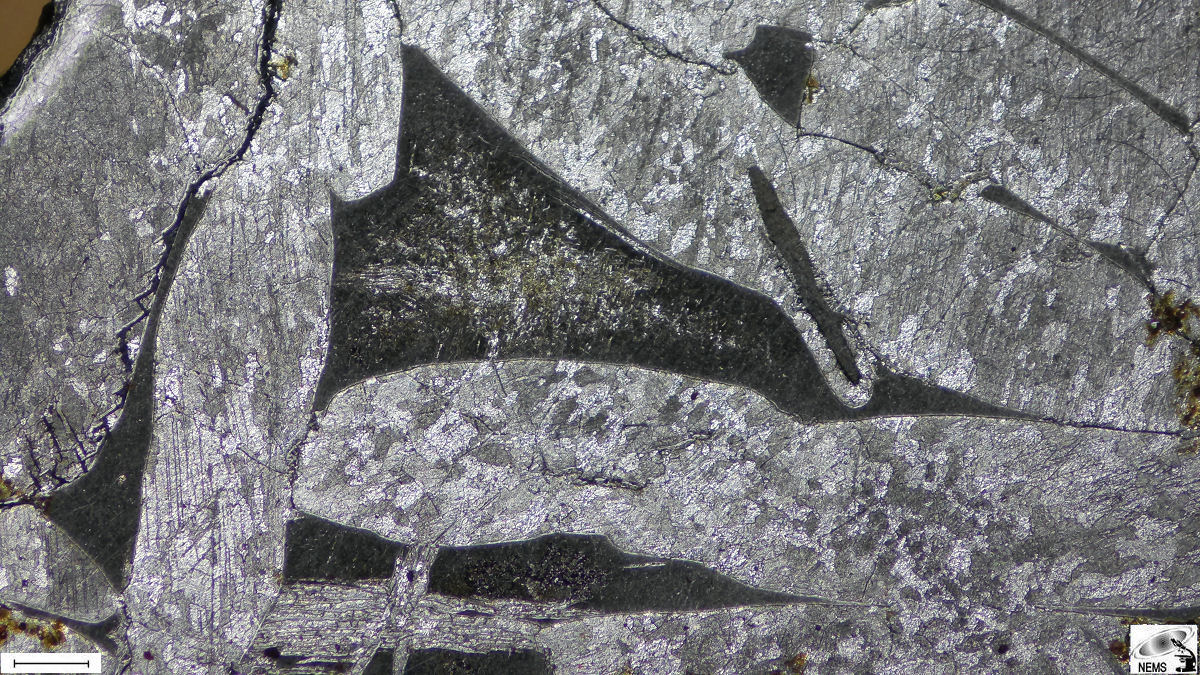
| Figure 2. Scale bar 1.6 mm |
| Meteorite, Paloduro |
| Classification, Iron, IIIE |
| Vickers hardness 340 |
| Strongly shocked, melted troilite, recrystallized kamacite. |
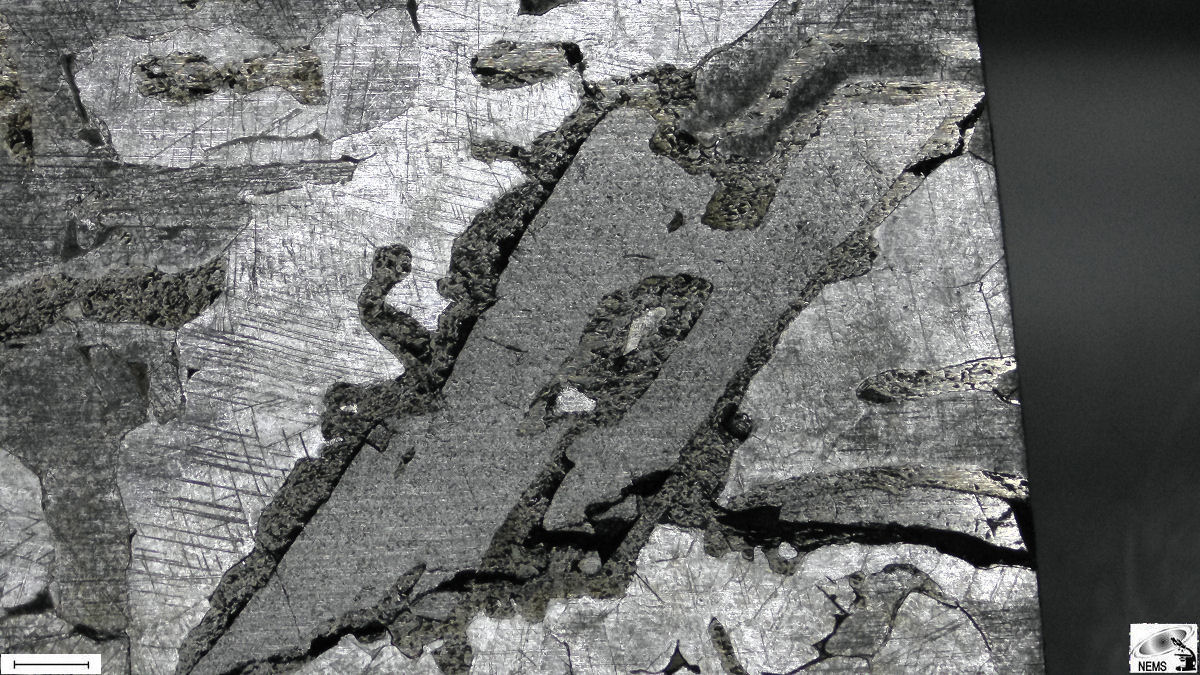
| Figure 3. Scale bar 900 µm |
| Meteorite, Deelfontein |
| Classification, Iron, IAB-MG |
| Vickers hardness 380 |
| Coss-hatched Neumann lines, deformed, shock-melted troilite, the graphite has a unidirectional texture, severly corroded cohenite. |
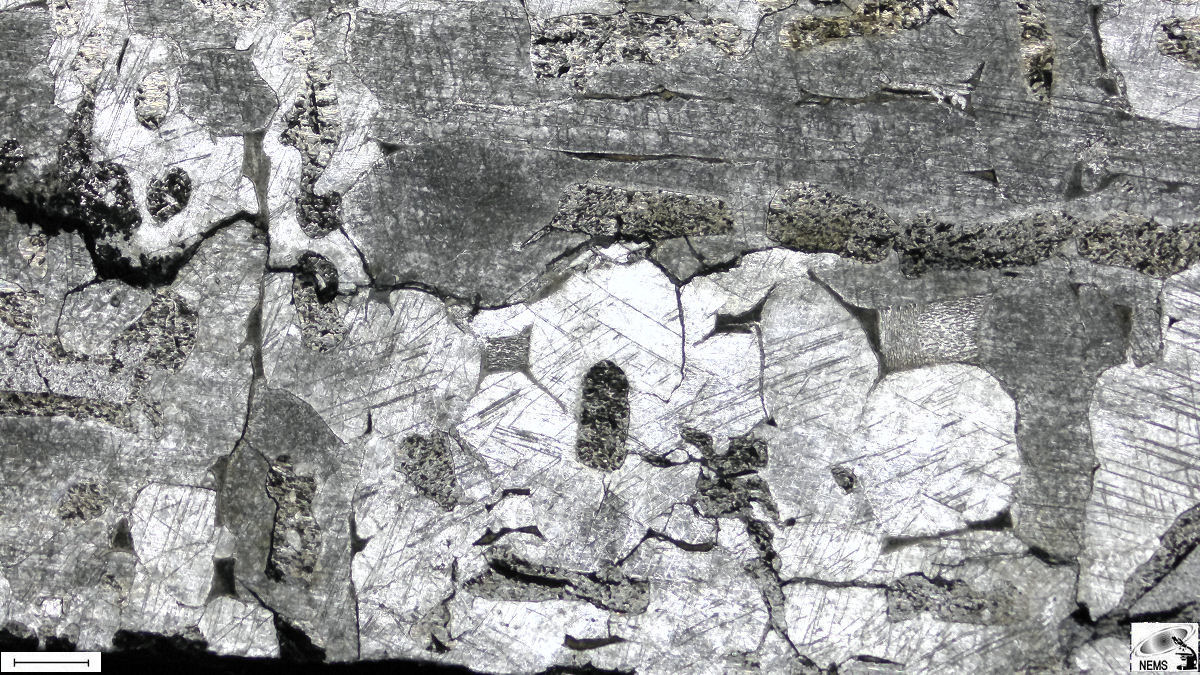
| Figure 1. Scale bar 600 µm |
| Meteorite, Deelfontein |
| Classification, Iron, IAB-MG |
| Vickers hardness 380 |
| Neumann lines, deformed, shock-melted troilite, severly corroded cohenite, rhabdites. |
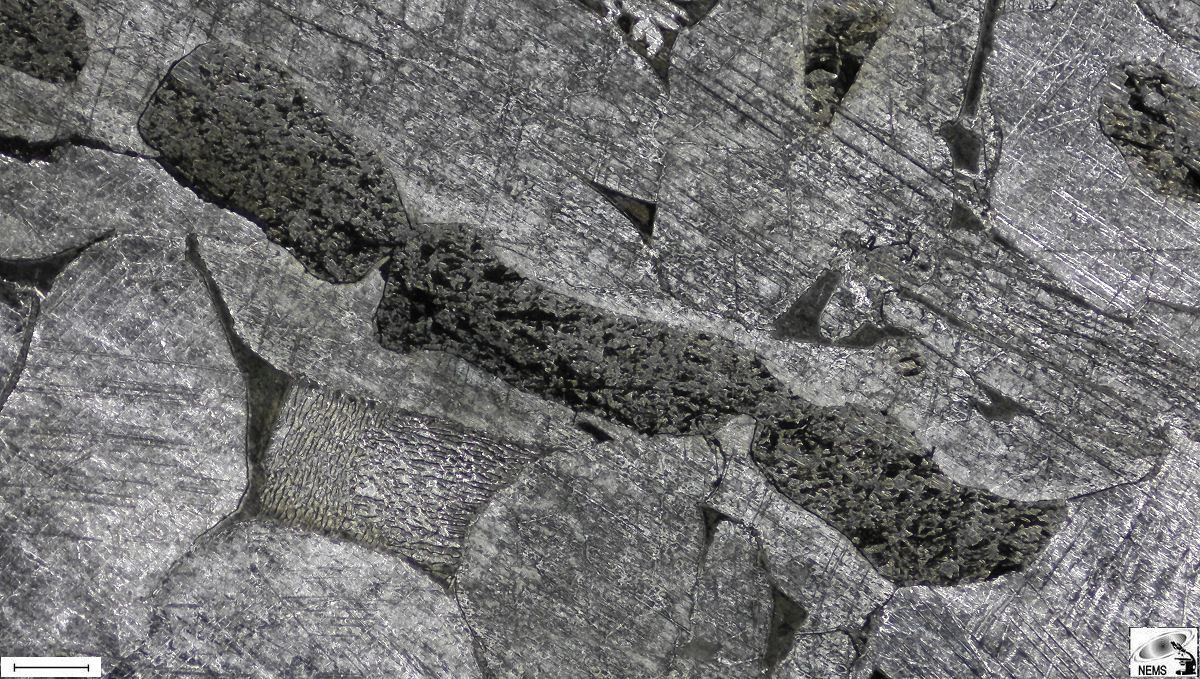
| Figure 5. Scale bar 400 µm |
| Meteorite, Deelfontein |
| Classification, Iron, IAB-mg |
| Vickers hardness 380 |
| Elongated decomposed cohenite inclusion. |
| References • Buchwald, V. F. (1975). Handbook of Iron Meteorites: Their History, Distribution, Composition and Structure. University of California Press / Center for Meteorite Studies, Arizona State University. (Primary reference for microhardness, structures, and shock effects in irons). • Lunar and Planetary Institute. Meteoritical Bulletin Database entries for Tamarugal, Paloduro, and Deelfontein. • Uhlig, H. H. (1955). The significance of Neumann bands in meteorites. Geochimica et Cosmochimica Acta, 7(1-2), 34–42. • Hu, J., et al. (2022). Formation, preservation and extinction of high-pressure minerals in meteorites: Temperature effects in shock metamorphism and shock classification. Meteoritics & Planetary Science. (For modern context on shock stages and features). |
| Listing of Structures |